The machine asks for its own spare part.
A human sets the limit, once.
Foreman watches vibration on a machining line, projects when a bearing will cross the ISO 10816-3 stop the machine threshold, and — if the part is out of stock and no supplier lead time beats the failure — buys it. Payment settles into on-chain escrow against a spend permission the plant manager signed weeks earlier, and releases to the supplier on confirmed receipt.
The control room is wired to Base Sepolia and spends real testnet money on your behalf. That is deliberate: the agent key holds 0.002 ETH of gas, the permission caps it at $2,000 a month, and nothing above $500 executes without a second key. A stranger hammering the button is bounded by the same contract the plant relies on.
Routine goes through
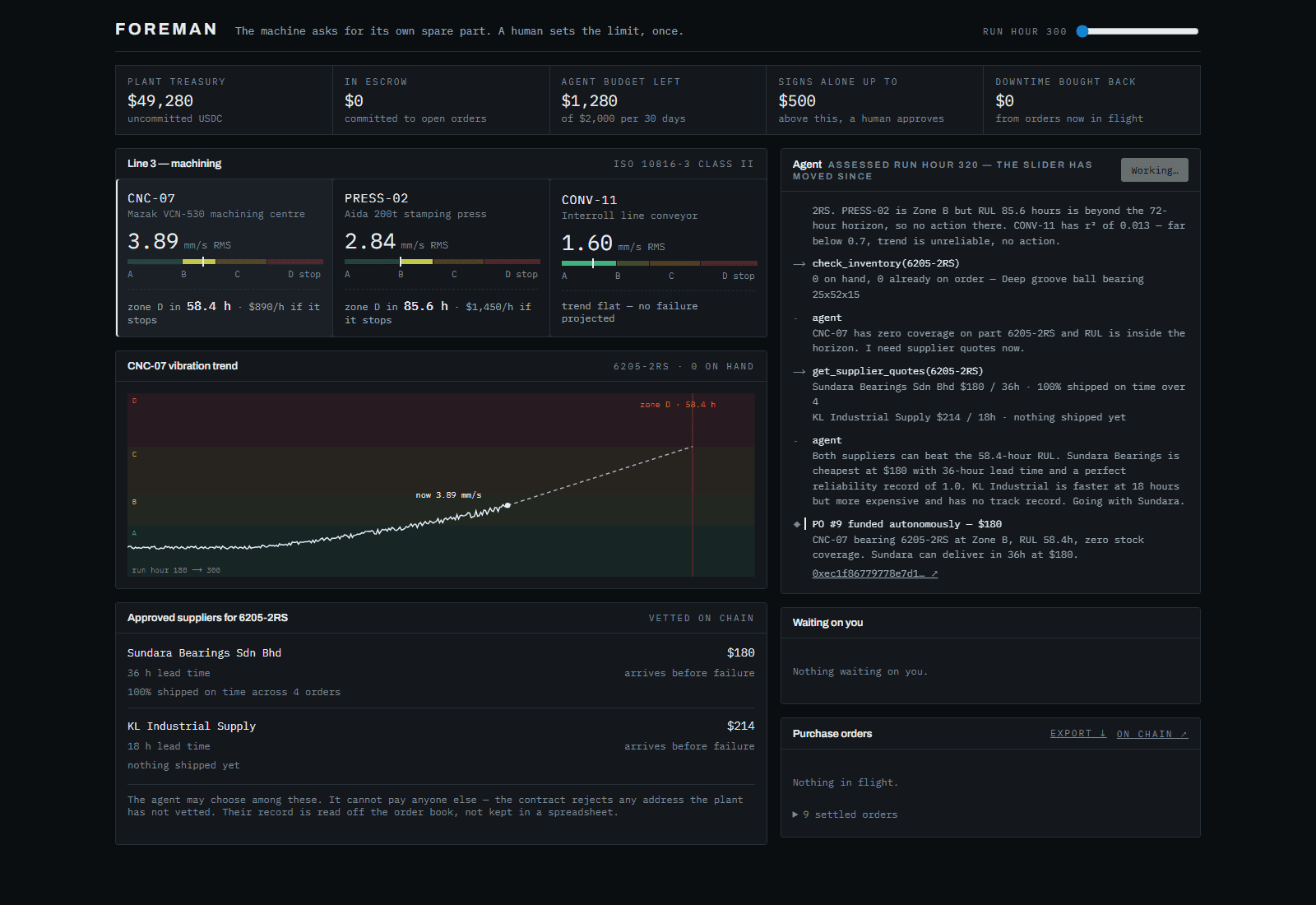
no humanA $180 bearing, 58 hours of life left, zero on the shelf, a vetted supplier who can deliver in 36. The agent proposes and funds it in one transaction, because it is under the ceiling. The line never stops and nobody raised a requisition.
Exceptions stop and wait
humanA $4,000 spindle is proposed and left there. No Funded event, no money moved, until a separate key approves it — and that approval bypasses the cap, because the cap bounds the agent, not the plant.
How it decides
ISO 10816-3 Class II- Trend, not threshold. Vibration RMS is fitted log-linearly to project the hour the machine crosses Zone D — a number of hours left, not a red light after the fact.
- Then check the store. On hand plus already on order, so the agent does not buy the same bearing twice while the first one is in transit.
- Then the suppliers. Quotes come off the vetted list with each supplier's delivered-on-time record read from the order book. One that cannot arrive before the failure is not a cheaper option, it is no option.
- Then it commits, or it does not. Under the ceiling it signs. Over it, or with no supplier fast enough, it says so and stops.
Telemetry never leaves for a model provider that retains it — the agent runs on Venice AI, which does not store inference data.
What the contract will not let it do
~250 lines- Invent a payee
- Payment only reaches an allowlisted supplier. A hallucinated or injected address is rejected at the contract, not by a prompt.
- Re-buy what is already coming
- A second order for the same part on the same machine reverts with
AlreadyOnOrder. A guarantee that lives only in application memory is not a guarantee. - Overspend
- The 30-day cap is checked on chain on every autonomous fund.
- Release escrow on a bare click
- The supplier commits a despatch document hash with their own key, and receipt reverts unless goods-in submits a reference that matches.
Live on Base Sepolia
verifiedForeman0x6cc8fafc87328a087ac0da2d0c8cae7f9bec2e9a
USDC (mock)0x4944908fa528e017340df511dbae5bbb8dc91720
Both are verified, so the bytecode running on Base Sepolia can be checked against the source in the repo rather than taken on trust.